Due to forecasted storms, free sand for sandbags is now available on a first-come, first-serve basis at nine City of Phoenix parks.
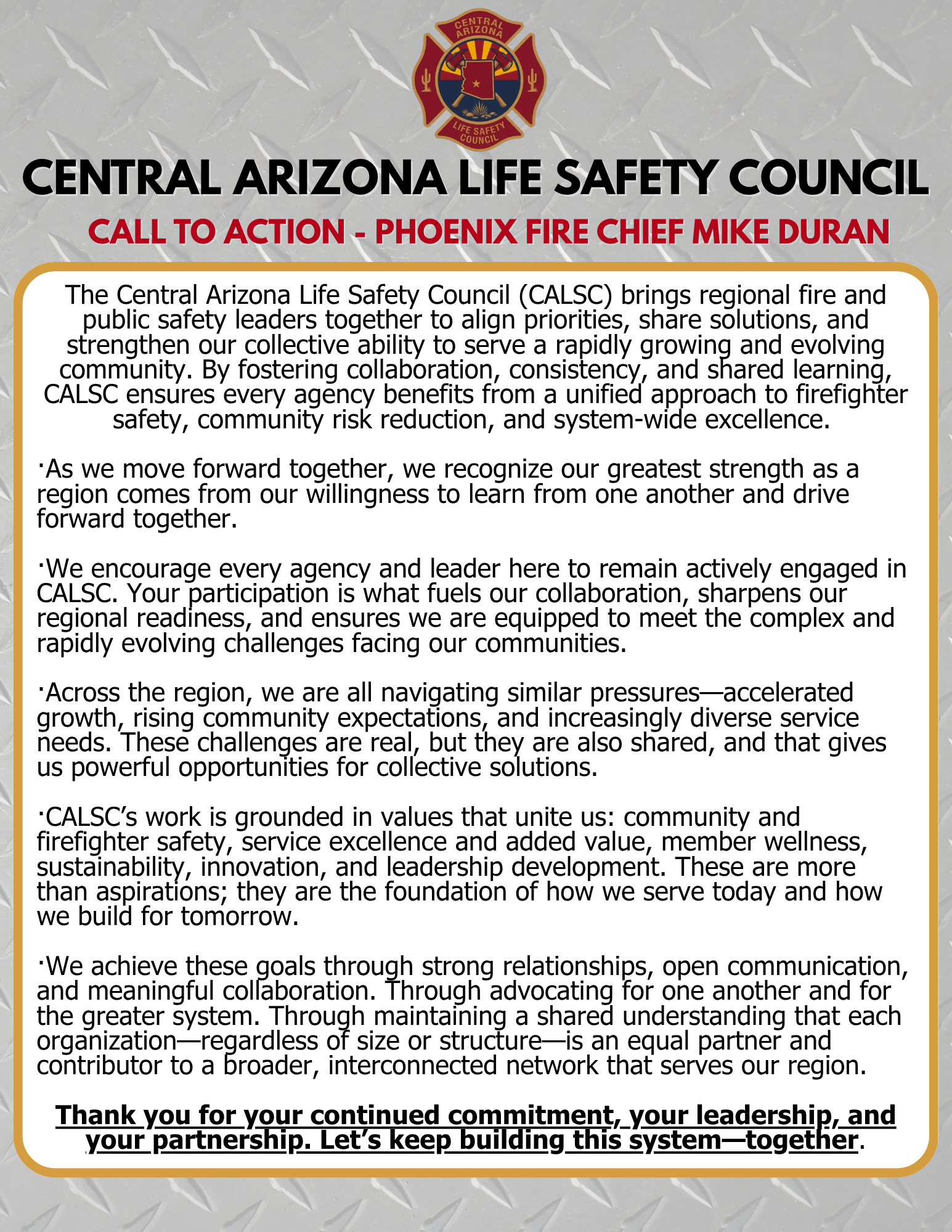
Central Arizona Life Safety Council (CALSC)
Welcome to the Central Arizona Life Safety Council!
Who We Are: The Central Arizona Life Safety Council (CALSC) comprises chiefs from the Valley's Fire Departments and Fire Districts who are members of the Automatic Aid System. The Automatic Aid System is a consortium of governments (cities, towns, and fire districts) joined by an intergovernmental agreement where the participants operate as one entity for improved and efficient emergency service delivery. It is a time-tested and globally recognized best practice that facilitates the identification of the closest, most appropriate resources to respond to emergency incidents, regardless of jurisdictional borders.
Our Mission: Our mission is to provide the leadership and necessary resources to ensure the highest levels of emergency service delivery to our residents. Our shared values are customer service and firefighter safety.
Our Executive Committee
The CALSC Executive Committee is responsible for core planning, setting long-term goals and priorities, monitoring the performance of CALSC committees, ensuring compliance with the Automatic Aid Agreement, and overseeing major initiatives. The Central Arizona Life Safety Council Executive Committee consists of a total of six members. The members include the Fire Chiefs from Phoenix and Mesa as permanent members, along with four rotating members, two from the East Valley and two from the West Valley Departments.
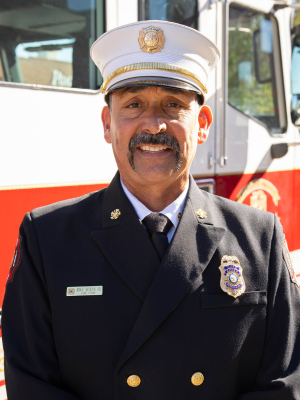
Fire Chief Mike Duran
Fire Chief Mike Duran III, a Phoenix native, has been a dedicated member of the Phoenix Fire Department since 1994. Appointed as Fire Chief in February 2022, he leads a metropolitan department comprising over 1,900 sworn firefighters and more than 400 civilian personnel, managing a budget exceeding $600 million. The department operates 78 administrative facilities and fire stations, serving a population of over 1.6 million.
Chief Duran's responsibilities encompass fire protection, medical services and transportation, the Community Assistance Program, special operations, emergency management, and community risk reduction and education programs.
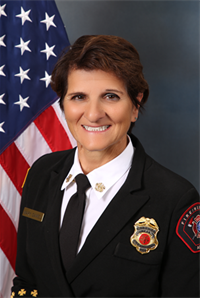
Fire Chief Mary Cameli
Mary Cameli is the Fire Chief and has served Mesa Fire and Medical Department (MFMD) for over 40 years.
She, along with the executive management team provides administrative direction and leadership for all MFMD divisions, programs, functions, and personnel.
Their responsibilities include working closely with City Management and City Council in support of community initiatives and ensuring the department reliably provides a high level of emergency response and other services to the community.
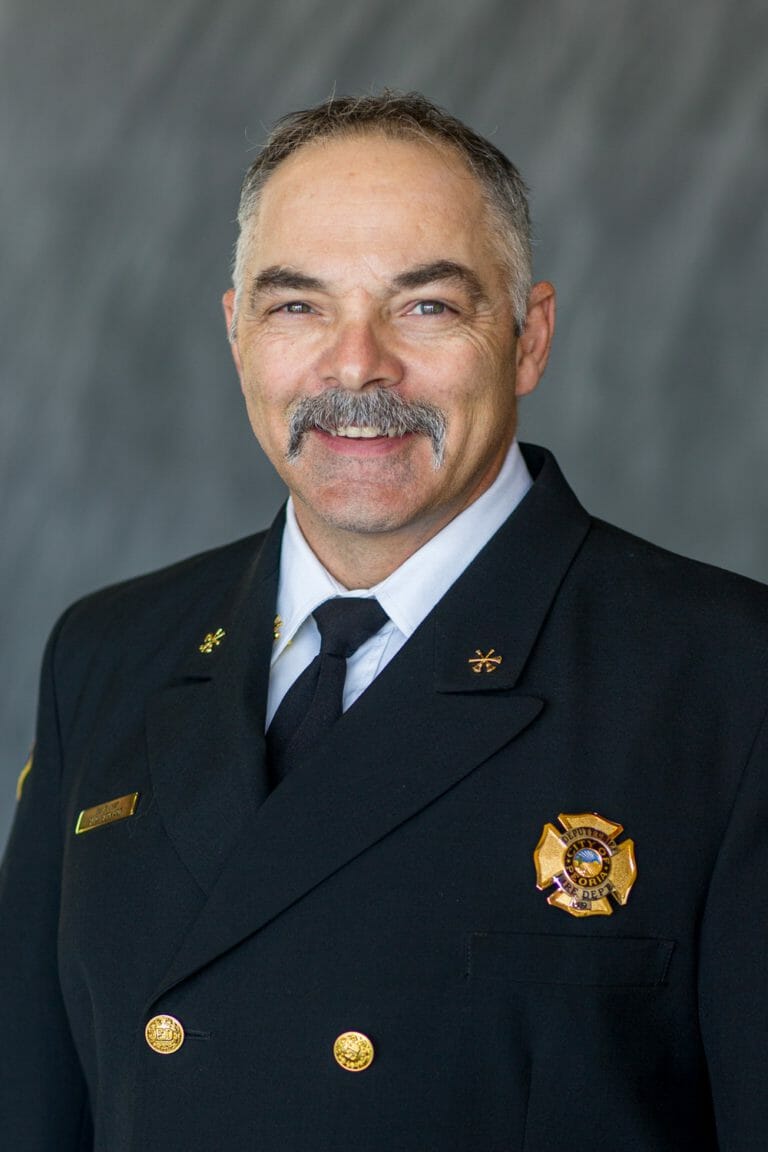
Fire Chief Gary Bernard
Chief Gary Bernard has been working for the Peoria Fire Department for more than 30 years and became chief on April 25, 2022.
He is the first chief in Peoria to go all the way through the academy and the ranks before receiving the position.
He has also won several awards for his strength and service, such as the Toughest Firefighter Alive twice, and the Aces of Hearts Leadership Award for coordinating an accident rescue.
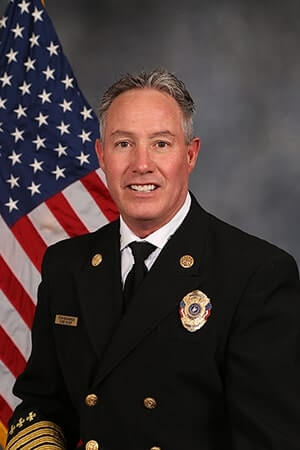
Fire Chief Tom Shannon
Tom Shannon has been a pivotal figure for the Scottsdale Fire Department, overseeing significant initiatives and changes since his appointment to Fire Chief in 2012. His leadership has been marked by a focus on public trust, operational readiness and the stewardship of resources and personnel.
Shannon's tenure has seen Scottsdale evolve from a suburban city to an internationall recognized destination. His commitment to public safety is evident in his department's effectiveness in growing with the City of Scottsdale and expanding its delivery of vital public safety services.
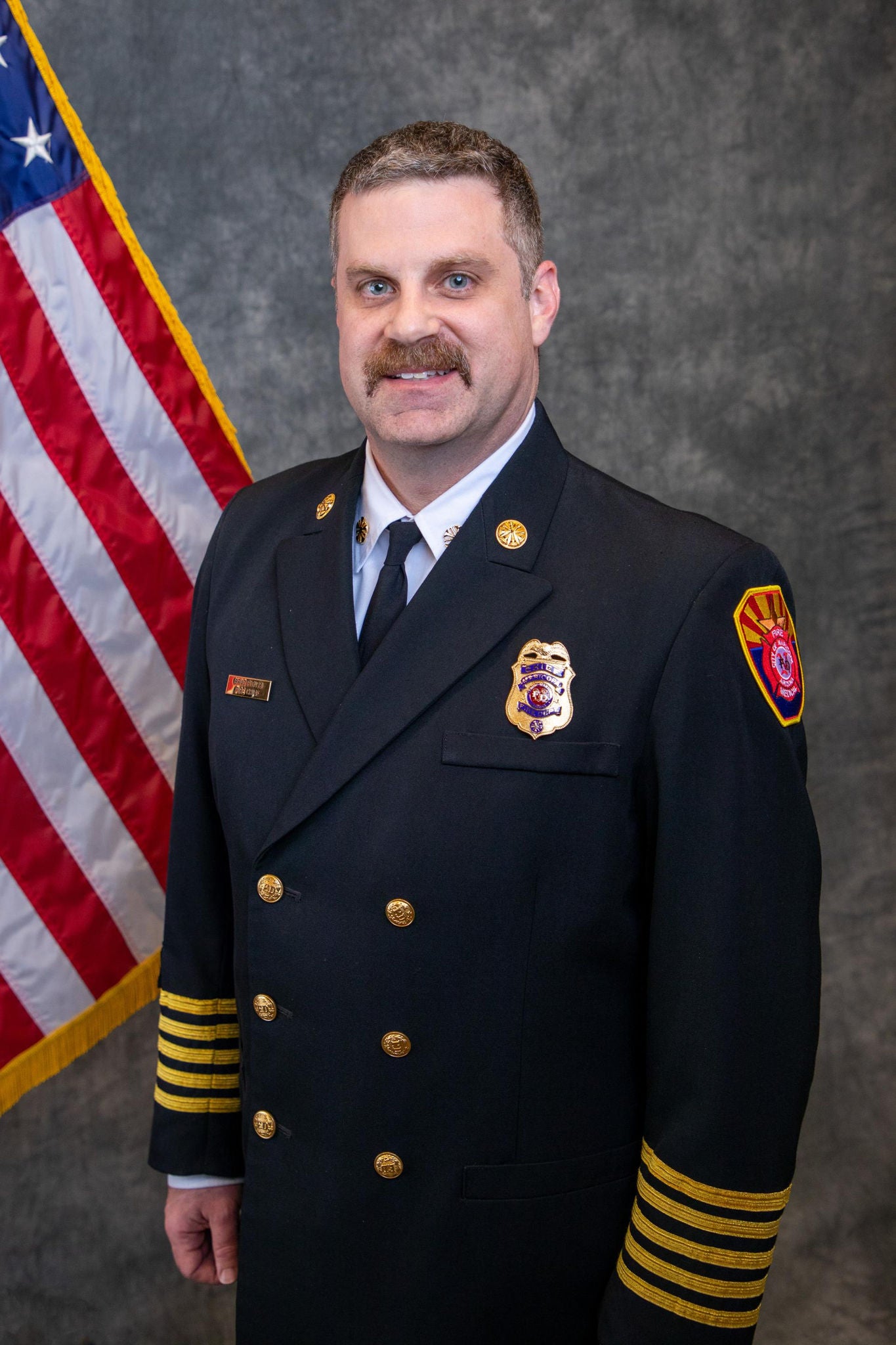
Fire Chief Brad Pitassi
Brad Pitassi was appointed as the Chief of the City of Maricopa Fire and Medical Department in 2022.
Pitassi began working in Maricopa in 2003 as an EMT for a private ambulance service. In 2006, he was hired as a firefighter for the Maricopa Fire District, which was officially annexed into the City the following year.
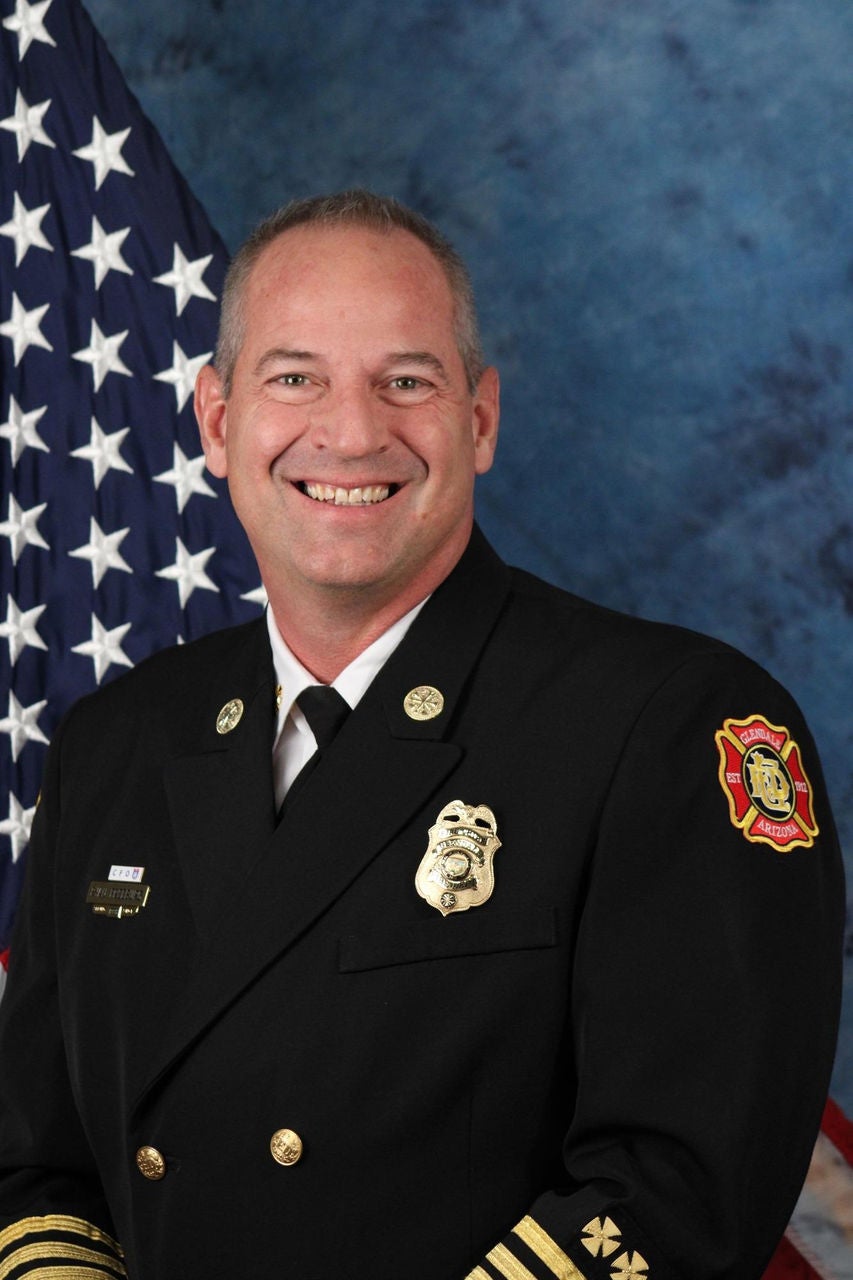
Fire Chief Ryan Freeburg
Ryan Freeburg has been the Fire Chief of the Glendale Fire Department since October of 2022.
His leadership is marked by professionalism, innovation and accountability, ensuring a culture of excellence within the Glendale Fire Department.
Freeburg's experience with large scale events showcases his understanding of the complex planning and dedication of resources needed for such events.
Executive Chief Tim Kreis
Tim Kreis began his career with the Phoenix Fire Department in 2002. Tim has worked in every operational capacity as a Firefighter, Engineer, and Fire Captain before being promoted to Command Officer.
Tim has participated in managing various large-scale planned events in the City of Phoenix. His experience includes serving as the Incident Commander for the All Hazards Incident Management Team and administering events in Phoenix associated with Super Bowl LVII.
Tim served as the Chairman of the Arizona Counter Terrorism Information Center Executive Board and the Co-Chair of the Arizona Statewide Mutual Aid Committee.
- Fire Chief Mike Duran
- Fire Chief Mary Cameli
- Fire Chief Gary Bernard
- Fire Chief Tom Shannon
- Fire Chief Brad Pitassi
- Fire Chief Ryan Freeburg
- Chief Tim Kreis
Strategic Planning Committee
CALSC Committees
The Regional Operations Consistency Committee (ROCC) exists to align regional emergency service delivery, ensuring Automatic Aid participants operate as a unified entity. This includes administering the standardized Incident Management System and managing Regional Standard Operating Procedures (e.g., Phoenix Volume II or Mesa 200 Series). The ROCC consists of the Operations Chiefs from every Automatic Aid Agency. Four agency Operations Chiefs representing the Phoenix, Mesa, Eastern, and Western departments lead ROCC efforts.
The Emergency Medical Services ROCC aligns regional emergency medical services to ensure Automatic Aid participants operate as one entity. This includes standardized emergency medical protocols, training, and equipment. The Emergency Medical Services ROCC collaborates with external stakeholders, such as the Arizona Department of Health Services, on behalf of CALSC, with a focus on enhancing the quality of care for our communities. The Emergency Medical Services ROCC consists of the EMS Chiefs and affiliated Medical Directors from every Automatic Aid Agency. Four members representing the Phoenix, Mesa, Eastern, and Western EMS Chiefs lead the Emergency Medical Services ROCC efforts.
The Regional Training and Standards Committee administers a comprehensive and consistent training program within the Automatic Aid System. This includes managing the baseline knowledge required for consistent task, tactical, and strategic operations. Also, the Regional Training and Standards Committee coordinates the activities and curriculum of all recognized regional training academies, command officer training, and incident safety officer system training. The Regional Training and Standards Committee comprises a representative from each Automatic Aid Agency. The Regional Training and Standards Committee is led by the Training Chiefs of those departments with approved regional training academies.
The Regional Physical Resources Committee exists to align regional apparatus, equipment, and PPE to ensure Automatic Aid agencies operate as one entity. All Automatic Aid participants must maintain equipment, including hoses, couplings, pump capacity, and minimum equipment standards on each type of apparatus, in compliance with the applicable National Fire Protection Association standards. When possible, the Regional Physical Resources Committee coordinates the purchase of emergency service resources to facilitate system-wide joint purchasing. The Regional Physical Resources Committee also shares best practices and industry standards for the design and construction of new and rebuilt fire stations, ensuring that facilities meet modern operational, safety, and sustainability requirements. The Physical Resources Committee comprises a representative from each Automatic Aid Agency. Four members representing the Phoenix, Mesa, Eastern, and Westerns lead the Regional Physical Resources Committee efforts.
Technology is crucial in the fire service, as it enhances safety, efficiency, and operational effectiveness. The Regional Communication, CAD, and Emerging Technology Committee exists to align regional communication equipment, computer systems, and emerging technologies, ensuring that Automatic Aid agencies operate as a unified entity. All Automatic Aid participants are focused on faster response times, optimized management, and improved readiness for emergency incidents. When possible, the Regional Communication, CAD, and Emerging Technology Committee leverages regional collaboration with vendors to facilitate joint purchasing and service agreements, thereby promoting system-wide cost reductions and service enhancements. The Regional Communication, CAD, and Emerging Technology Committee consists of representatives from every Automatic Aid Agency. Four members representing the Phoenix, Mesa, Eastern, and Westerns lead the Regional Communication, CAD, and Emerging Technology Committee efforts.
The Regional Community Risk Reduction Committee aligns efforts to identify and reduce risk occurrences within the Automatic Aid system by focusing the resources of all Automatic Aid agencies and building strategic partnerships. Efforts include coordination on public education, engineering solutions, fire code adoption and enforcement, economic incentives, and support of emergency response efforts. Four members representing the Phoenix, Mesa, Eastern, and Westerns lead the Regional Community Risk Reduction Committee efforts.
The Regional Health and Safety Committee coordinates regional health and safety efforts to ensure Automatic Aid participants operate as one entity. These include, but are not limited to, injury prevention, initiatives to reduce firefighter cancer, data collection and research, emerging technologies, and professional safety development. Four members representing the Phoenix, Mesa, Eastern, and Westerns lead the Regional Health and Safety Committee efforts.
The History of the Automatic Aid System
This video from 1996 shows the genesis of the Automatic Aid System and the philosophies that constitute the core principles still in use today.